Resources
LHE Electronics > Blog > How to Choose the Right PCB Connector?

How to Choose the Right PCB Connector?

In electronic system design, failures are rarely caused solely by chips or processors. In many real-world scenarios, reliability issues often stem from connection points. PCB connector selection is typically done late in the design process, despite their crucial role in signal integrity, power delivery, and long-term stability.

PCB connectors establish electrical and mechanical interfaces between printed circuit boards, cables, or external devices. While the component itself may seem simple, differences in its construction, materials, and mounting methods can significantly impact system performance.

This article will introduce the types, technical specifications, materials, and applications of PCB connectors, focusing on how to select connectors based on actual design constraints rather than theoretical specifications.

What are the Different Types of PCB Connectors?

PCB connectors are commonly categorized by how they create electrical connections.

Board-to-Board Connectors

Board-to-board connectors directly link two PCBs without intermediate wiring. Traditional pin headers and receptacles are widely used in development boards and cost-sensitive designs because they are easy to source and flexible during prototyping. However, they offer limited resistance to vibration and are not ideal for compact or high-speed systems.

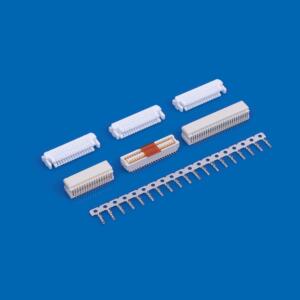
Mezzanine connectors, sometimes referred to as stacking connectors, are designed for parallel board connections with low profile and high pin density. They are frequently used in embedded computing modules, display interfaces, and industrial control boards where space efficiency matters.

Wire-to-Board Connectors

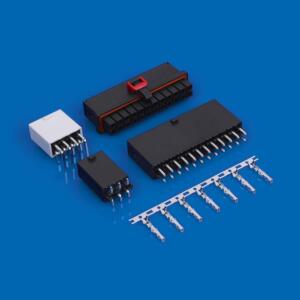
Wire-to-board connectors connect discrete wires to a PCB and are commonly found at power inputs and signal interfaces. Terminal blocks are typical in industrial equipment, where secure clamping and field serviceability are required. IDC connectors simplify cable assembly by eliminating wire stripping, making them suitable for ribbon cable applications, though they are less tolerant of mechanical stress.

FPC and FFC connectors are optimized for flat flexible cables and are widely used in consumer electronics such as smartphones, cameras, and displays, where thin form factors and tight routing are necessary.

Key Technical Specifications of PCB connectors

Reading a connector datasheet requires understanding several core parameters.

Pitch refers to the spacing between adjacent contacts. Smaller pitches such as 0.5 mm are used in compact consumer devices, while larger pitches around 2.54 mm or above are common in general-purpose or power-related applications. As pitch decreases, manufacturing tolerances become more critical.

Current and voltage ratings define the electrical limits of a connector. Power connectors are designed to handle higher current per contact, whereas signal connectors prioritize isolation and stable transmission. These ratings should always be considered with derating factors such as temperature rise and number of active contacts.

Contact resistance affects voltage drop and signal quality. Lower resistance is particularly relevant for high-speed data lines and low-level signals, where small losses can affect performance.

Mating cycles indicate how many insertion and removal operations a connector can withstand. Consumer electronics usually require relatively few cycles, while industrial or test equipment may require hundreds or more. Selecting a higher mating-cycle connector than necessary can increase cost without practical benefit.

Mounting style also influences performance. Through-hole connectors provide stronger mechanical anchoring and are often used where cables apply stress to the PCB. Surface-mount connectors support automated assembly and higher density but require careful footprint design to manage mechanical loads.

A2502A2502

Materials and Plating of PCB Connectors

Connector reliability is closely tied to material selection.

Insulating housings are typically made from high-temperature plastics such as LCP or reinforced nylons like PA9T and PA6T. These materials are chosen for their ability to withstand lead-free reflow soldering while maintaining dimensional stability.

Contacts are usually stamped from phosphor bronze, brass, or beryllium copper. Phosphor bronze offers a balance of conductivity and mechanical strength, while beryllium copper provides higher spring force for demanding applications.

Plating further affects performance. Gold plating offers stable contact resistance and corrosion resistance, making it suitable for low-signal or long-life applications. Tin plating is more economical and easier to solder but can oxidize over time, particularly in harsh environments.

Critical Industry Applications: Why PCB Connector Selection Matters

Consumer Electronics

In the realm of smartphones, wearables, and IoT devices, space is the ultimate premium. Connectors must facilitate high-speed data transfer within microscopic footprints.

Key Requirements: Fine pitch, low-profile heights, and compatibility with high-speed SMT assembly.

Common Solutions: FPC/FFC connectors and high-density Mezzanine connectors are used to stack PCBs efficiently.

Automotive Electronics

Modern vehicles are “computers on wheels,” requiring connectors that can survive the engine bay and the chassis. Failure here isn’t just a glitch; it’s a safety risk.

Key Requirements: Resistance to extreme thermal cycling, high-frequency vibration, and mechanical shock.

Security Features: Integration of TPA and CPA locking mechanisms to prevent accidental decoupling.

Industrial Automation & PLC

Industrial control systems and PLCs operate in “electrically noisy” environments where downtime is expensive.

Key Requirements: High EMC shielding, dust resistance, and long-term contact stability.

Design Focus: Heavy-duty shrouding and gold-plated contacts are standard to prevent oxidation in environments with high humidity or chemical exposure.

Medical Technology

Medical-grade connectors are governed by strict regulatory standards, where consistency is a legal requirement.

Key Requirements: High mating cycle durability for reusable probes, biocompatible materials, and resistance to chemical sterilization.

Critical Factor: Low-insertion force (LIF) designs are often used to ensure delicate medical equipment isn’t damaged during frequent assembly and disassembly.

PCB Connector Troubleshooting: Causes and Solutions

Connector reliability is the cornerstone of system uptime. Most failures stem from three main factors: environmental degradation, assembly defects, and mechanical stress.

Environmental and Electrical Degradation

The most common “hidden” failure is increased contact resistance. When connectors are exposed to moisture or contaminants, oxidation and galvanic corrosion form a non-conductive layer on the pins. This can lead to intermittent signal loss or localized overheating.

Professional Tip: To ensure signal integrity, gold plating (Au) is recommended for low-signal applications, and consider using conformal coatings to shield against corrosive environments.

Assembly and Manufacturing Integrity

Reliability issues often arise at solder joints. Problems such as cold solder joints or solder bridging can affect electrical continuity from the outset.

Furthermore, solder absorption can cause contacts to become overly stiff, leading to premature fatigue.

Design Improvement: Ensure your PCB package conforms to IPC-7351 standards to ensure optimal solder paste usage and heat dissipation during assembly.

Mechanical stress and physical fatigue

Physical interactions can cause pad lifting or solder joint cracking. In high-vibration environments, even if the connector remains plugged in or unplugged, fretting corrosion can wear down the plating.

Ruggedization measures: For high-flow I/O ports, use through-hole mounts or connectors with integrated solder pads to transfer the mechanical stress on the pads to the PCB substrate.

Conclusion

While connectors are typically the smallest component in the bill of materials, they are a critical element determining the long-term reliability and production yield of equipment. As the industry evolves, the convergence of miniaturization, ultra-high-speed data protocols, and fully automated production is no longer a trend, but a fundamental requirement.

At LHE, we are dedicated to bridging the gap between complex engineering needs and scalable manufacturing. We provide high-precision, high-reliability connector solutions that balance mechanical durability and signal performance, helping engineers create future-proof designs to meet the demanding challenges of modern electronic environments.

Frequently Asked Questions

What does connector pitch mean?
Pitch is the center-to-center distance between adjacent contacts and determines how densely contacts can be arranged.

Are SMT connectors less durable than through-hole connectors?
SMT connectors can be reliable when mechanical stress is properly managed through layout design and enclosure support.

How can incorrect mating be prevented?
Keying features, asymmetric housings, and mechanical guides are commonly used to prevent incorrect insertion.

INQUIRY NOW